What Does It Mean That Jesus Christ Is the Logos?
What Does It Mean That Jesus Christ Is the Logos?
In Christian theology, the Logos or the Word is the name given to the pre-existent Christ, the second person of the Trinity.
According to the creeds established during the period of the Church or Apostolic Fathers, the pre-existent Christ or Logos was generated eternally out of the substance of God the Father and is true God of true God.
It is this eternally generated Logos, this pre-existent heavenly Christ, of whom the Logos was made flesh (Jesus) and born among men.
“In Christian theology, the Logos or the Word is the name given to the pre-existent Christ, the second person of the Trinity.”
The name Logos was applied to Jesus Christ by John (see John 1). Drawing on the philosophy of Philo, John used the term Logos or Wisdom as a designation of a pre-existent mind which primarily contained the intelligible world of ideas and secondarily, from Jewish thought, as a designation of the pre-existent Law.
The conception of a pre-existent Christ is derived from the Jewish teaching of a pre-existent Messiah.
Paul called the pre-existent Christ, “Wisdom” or “Logos.” Logos is a term in Judaism that applies to pre-existent Law.
Paul thus combined the Jewish conceptions of the pre-existent Messiah and pre-existent Law.
Although Paul describes the pre-existent Christ as “God’s own Son being equal with God,” and John describes the Logos as “the only begotten Son of God being God,” there was no certainty whether these descriptions were literal or were an indication of the manner in which the pre-existent Christ (Logos) came into existence; until the earliest Church Fathers took these descriptions literally.
That is, they said the Logos was generated out of the substance of God and not created by Him out of nothing, as was the case when God created the world.
They logically concluded that the pre-existent Christ was generated out of the substance of God as they reasoned that which is generated must be of the same substance as that which generates.
But the view that such was an eternal process was not introduced until about 200 AD by Irenaeus and Origen.
Before then, the early Church Fathers said that the Logos existed from eternity in God Himself, and only prior to the creation of the world was Christ created out of the substance of God as a real personal being.
This view of a two-fold stage in the existence of the Logos has virtually disappeared, but to my knowledge it was never formally denounced by any of the church councils.
Interestingly, the principal of the eternity of the process of the generation is not explicitly expressed in the creeds.
In opposition to this eternal view of the Logos there appeared, during the period of the Church Fathers, two heretical views.
“They logically concluded that the pre-existent Christ was generated out of the substance of God as they reasoned that which is generated must be of the same substance as that which generates.”
First there was the Arian view that the Logos was created out of nothing and consequently was not God.
This view was condemned at the Council of Nicaea in 325 but it is still held by some non-Trinitarians and many in the New Age movements.
Second, was the Sebellian view that the Logos was not a real personal being but merely “a power of God.”
This view was condemned at the Council of Constantinople in 381. It too is held by some non-Trinitarians as well as by those who preach the “prosperity, name it and claim it gospel.”
This Sebellian view is championed by many popular nonsensical New Age spiritual teachings.
One can read of it in Rhonda Byrne’s esoteric book, “The Secret” which deals with Law of Attraction.
It appears throughout Eckhart Tolle’s mumbo-jumbo book, “The New Earth” which states that “Man made God in his own image” (p. 15).
Tolle calls for us to transcend our state of consciousness into a new awakening, which has been referred to by Oprah Winfrey as a Kabbalah (a mystical receiving or accepting) because in such teaching, “we are god.”
Thus, according to Tolle and Winfrey, we are the logos; and therein do we currently find these ancient heretical teachings alive and well in contemporary times.

Paul Tambrino, PhD, EdD is President Emeritus of the Iowa Valley Community College District, and former Academic Vice President of Warren County Community College. He has also taught accounting and theology at several colleges and seminaries, writes a weekly newspaper column, and is the author of Ask Augustine and Mariology: Past, Present and Future. He holds a Doctor of Philosophy in Theology from Trinity Seminary, and a Doctor of Education from Temple University. Paul was awarded the honorary rank of a three-star general at the US Air War College, Air War University-class of 1997 and he is a Paul Harris Fellow in Rotary International.
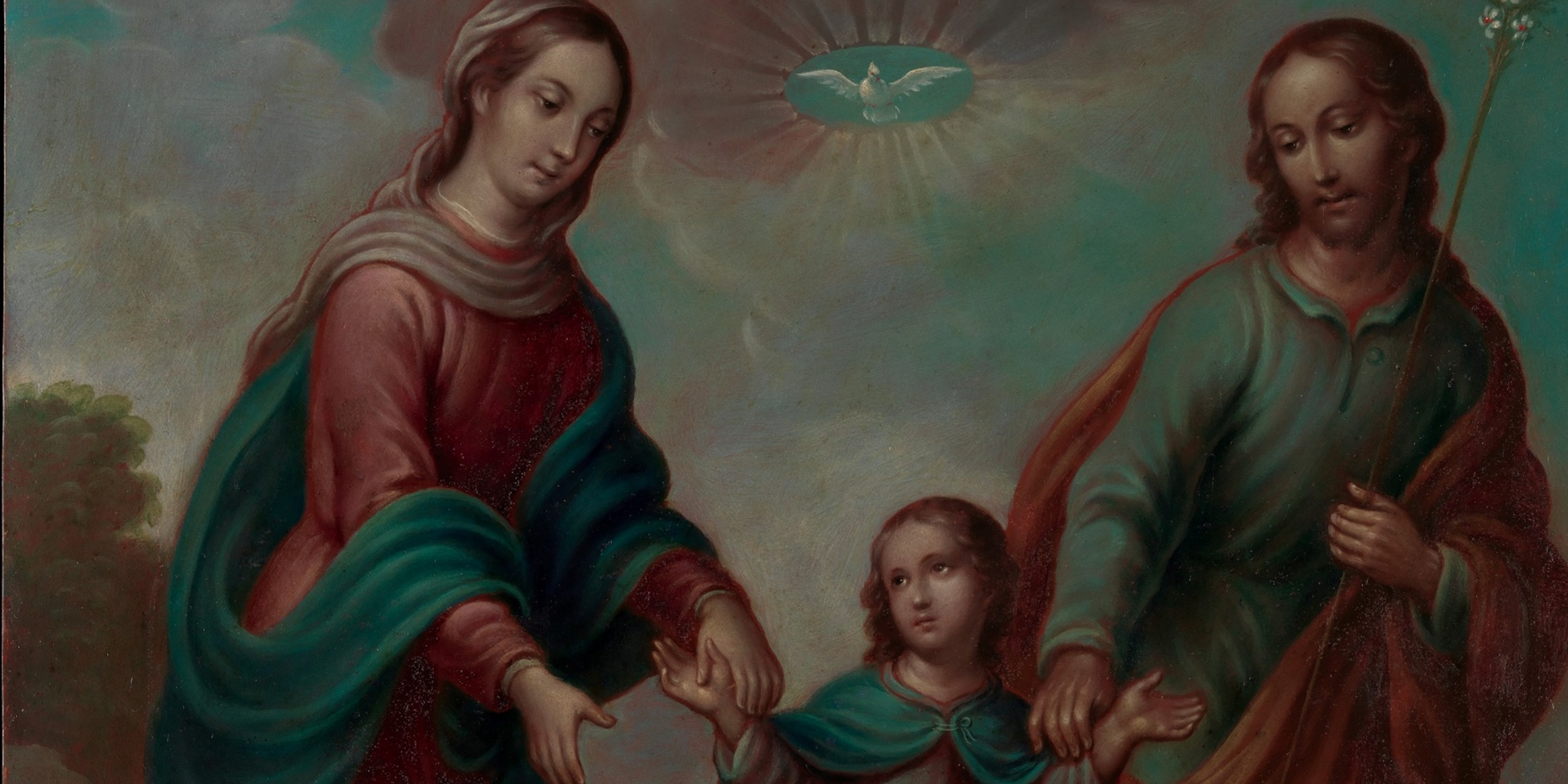
Image Credit: The Return of the Holy Family from Egypt by Nicolás Enríquez (Mexican, 1773). The Metropolitan Museum of Art, New York.