Why Do Some Christians Clasp Their Hands When They Pray?
Why Do Some Christians Clasp Their Hands When They Pray?
Clasping the hands in prayer is merely a conventional form of holding up the hands toward heaven.
The earliest imitation of a posture assumed by the Israelites during prayer is found in Exodus 17, where Moses held up his hands during a battle between his people and Amalek.
We first read of the offering of sacrifice and prayer being associated in Leviticus 9:22, “And Aaron lifted up his hand toward the people, and blessed them, and came down from offering of the sin offering, and the burnt offering, and peace offerings.”
Psalm 141:2 says, “Let my prayer be set forth before thee as incense; and the lifting up of my hands as the evening sacrifice,” and 143:6, “I stretch forth my hands unto thee.”
“No particular posture of prayer is prescribed in the Bible. The bodily attitudes assumed during prayer are standing, sitting, kneeling, bowing toward the ground and prostrating oneself. All these positions imply humility, respect and reverence.”
In Nehemiah 8:6 we read, “And Ezra blessed the Lord, the great God. And all the people answered, Amen, Amen, with lifting up their hands: and they bowed their heads, and worshipped the Lord with their faces to the ground.”
Stretching out the hands seems to be a natural attitude assumed by inferiors when asking favors of, presenting petitions or doing homage to, superiors and is apparently one of the primitive instincts of the human race.
However, no particular posture of prayer is prescribed in the Bible. The bodily attitudes assumed during prayer are standing, sitting, kneeling, bowing toward the ground and prostrating oneself. All these positions imply humility, respect and reverence.
Isaac Disraeli, in Curiosities of Literature, wrote: “To bend and prostrate one’s self to express sentiments of respect appears to be a natural motion; for terrified persons throw themselves on the earth when they adore invisible beings.”
According to 1 Samuel 1:26, Hannah, the mother of Samuel, stood when she prayed to the Lord, and 1 Kings 8:22 says, “And Solomon stood before the altar of the Lord in the presence of all the congregation of Israel, and spread forth his hands toward heaven.”
“Kneeling, bowing the head and prostrating the body were gestures of honor and respect as well as of worship and prayer.”
In the parable of the Pharisee and the publican, who went into the temple to pray, both stood, but the publican would not even lift his eyes to heaven but struck his breast. 2 Samuel 7:18 tell us that David sat before the Lord when he prayed.
Kneeling, bowing the head and prostrating the body were gestures of honor and respect as well as of worship and prayer.
Genesis 43:26 says Joseph’s brothers bowed down and made obeisance to their brother. When Joseph rode in Pharaoh’s chariot they cried out before him to bend the knee.
Isaiah 45:23 says, “unto me every knee shall bow.” In Genesis 24:26 we are told that the man bowed his head and worshipped the Lord.
“O come, let us worship and bow down: let us kneel before the Lord our maker,” says Psalm 95:6.
According to Daniel 6:10, Daniel kneeled three times a day and prayed. Ezra, in Ezra 9:5 says, “I fell upon my knees, and spread out my hands unto the Lord my God.”
Jesus, in Luke 22:41, kneeled down and prayed and Acts 7:60 says Stephen kneeled down. Luke 17:16 tells us that the Samaritan leper who had been healed fell on his face at the feet of Jesus and gave Him thanks.

Paul Tambrino, PhD, EdD is President Emeritus of the Iowa Valley Community College District, and former Academic Vice President of Warren County Community College. He has also taught accounting and theology at several colleges and seminaries, writes a weekly newspaper column, and is the author of Ask Augustine and Mariology: Past, Present and Future. He holds a Doctor of Philosophy in Theology from Trinity Seminary, and a Doctor of Education from Temple University. Paul was awarded the honorary rank of a three-star general at the US Air War College, Air War University-class of 1997 and he is a Paul Harris Fellow in Rotary International.
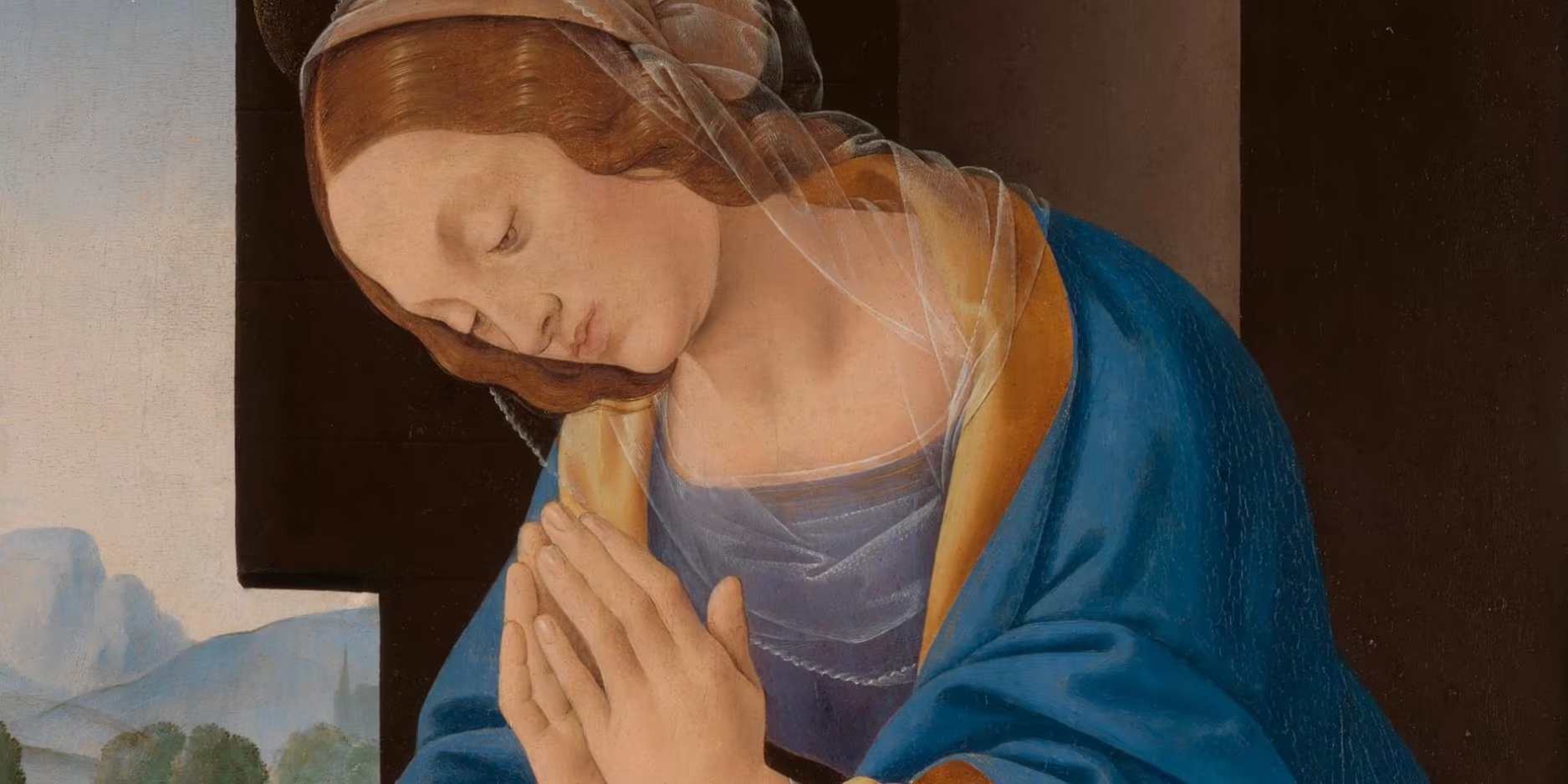
Image Credit: Madonna Adoring the Child with the Infant Saint John the Baptist and an Angel by Lorenzo di Credi (Lorenzo d’Andrea d’Oderigo) Italian, early 1490s. The Metropolitan Museum of Art, New York. 09.197.
Thank you for reading this article about praying posture. To read more articles like this one about praying posture visit our Topics page.