Ask the Pastor: Why Did Jesus Die?
Ask the Pastor is a regular column at Every Reason to Believe where pastor Reagan Marsh answers a variety of reader questions about ministry, Christianity, the church, and more…all from the perspective of the pulpit. You can find all of his articles here.
Why Did Jesus Die?
Why Did Jesus Die? This is the most important question to ask in all of human history, and it’s the most important to answer in every human’s life. It’s also the central and most frequent question I’ve received as a pastor.
To answer biblically, we must first understand who Jesus is. Jesus is the only-begotten Son of God, God-equal-with the Father and the Holy Spirit, and Lord over all things.
“Jesus is the only-begotten Son of God, God-equal-with the Father and the Holy Spirit, and Lord over all things.”
The Apostles’ Creed summarizes hundreds of biblical texts when it affirms that the Son of God was, in his humanity, “conceived by the Holy Spirit; born of the virgin Mary; suffered under Pontius Pilate; was crucified, dead, and buried; he descended into hell; on the third day he rose again from the dead. He ascended into heaven; from there he will come to judge the living and the dead.”
Jesus is the promised Seed of the woman (Gen. 3:15), the “Word [which] became flesh” (Jn. 1:1, 14), and the Messiah whose birth, life, death, and resurrection fulfilled, accomplished, and consummates the promises, prophecies, shadows, and types of the Old Testament (Jn. 6:39).
He’s God entering time, God with us, Immanuel, the long-awaited promised one to whom all of Scripture points.
Next, we must consider how death is seen in Scripture.
1. Death is the physical separation of body and soul for a time. It doesn’t mean that a man ceases to exist. For the Christian, his soul is made perfect in holiness (Heb. 12:23), and immediately passes into glory (Phil. 1:23; Lk. 23:43), while his body is still united to Christ (1 Thess. 4:14), resting in the grave (Is. 57:2) until the resurrection (Job 19:26-27).
2. Death is spiritual in nature (Eph. 2:1, 4). We’re born dead in our sins and cannot please God (Rom. 8:5-8) or make ourselves alive again. Spiritual death pervades our every thought, motive, and action, dominating us in every way; it shows our need of God to regenerate us, to make us alive.
3. Death is eternal in duration. John 3:16 speaks of “eternal life”; its opposite is in view when Matthew 25:41 speaks of “eternal fire,” or 2 Thessalonians 1:8-9 refers to “…flaming fire, inflicting vengeance on those who do not know God and do not obey the gospel of our Lord Jesus. They will suffer the punishment of eternal destruction, away from the presence of the Lord and from the glory of his might…” Luke 3:17 references “unquenchable fire” in the same sense.
“The nature of Christ’s death is stunning, against the backdrop of human brokenness.”
Romans 5:12-21 explains death in the framework of two Adams. The first Adam sinned (Gen. 3), “and death [came into the world] through sin, and so death spread to all men…” (Rom. 5:12).
Paul affirms in Romans 5:15 that “…many died through one man’s trespass…” and in Romans 5:16-17 that “the judgment following one trespass brought condemnation… through one man’s trespass, death reigned…” So all people sinned and died through Adam’s original sin.
We are now born “dead in trespasses and sins” (Eph. 2:1); we are born as sinners and rebels against God by nature and choice—as aliens from grace. That’s the cause and nature of human death.
But this Second Adam changes things; and here we come to our initial question concerning Christ’s death.
“Indeed, death could not hold him (Acts 2:24) because he is ‘the Author of life’.”
The nature of Christ’s death is stunning, against the backdrop of human brokenness. He entered into physical death (Ps. 22:15, Jn. 19:33-37) and spiritual death (Ps. 22:1, Matt. 27:46) but did not enter eternal death; the one “who inhabits eternity” (Is. 57:15) has “the keys of death and hell” (Rev. 1:18).
Indeed, death could not hold him (Acts 2:24) because he is “the Author of life” (Acts 3:15).
Jesus died in divine condescension as the God-man, fully divine and fully human. He died in innocence as the sinless Second Adam, as Romans 5:19 affirms: “For as by the one man’s [Adam’s] disobedience the many were made sinners, so by the one man’s [Christ’s] obedience the many will be made righteous.”
He died in obedience, in what theologians refer to as the “active and passive righteousness” of Christ. He was “obedient unto death, even the death of the cross” (Phil. 2:8).
“Jesus died in divine condescension as the God-man, fully divine and fully human. He died in innocence as the sinless Second Adam.”
As the perfectly obedient Second Adam, Jesus died in fulfillment of the Law of God which we have all broken (Matt. 5:17-18), thus accomplishing righteousness for his people—hence his “obedience” in Phil. 2:8. His was “obedience unto death, even the death of the cross”—the Law of God demands payment for sin, and Jesus paid it all.
Jesus suffered and died in the stead of his people, as the one substitute for sinners, the “righteous for the unrighteous” (1 Pet. 3:18).
Isaiah 53:5-6 gives a marvelous exposition of why Christ died, looking through this lens of substitutionary atonement: “But he was wounded for our transgressions; he was crushed for our iniquities; upon him was the chastisement that brought us peace, and with his stripes we are healed.
All we like sheep have gone astray; we have turned—every one—to his own way; and the Lord has laid on him the iniquity of us all.”
“In short, Christ died ‘to bring us to God’.”
Isaiah 53:10 shows that Jesus also died as the only sacrifice that pleased God, the only “guilt offering” that a holy God could ever accept: “It was the will of the Lord to crush him; he has put him to grief; when his soul makes an offering for guilt, he shall see his offspring; he shall prolong his days.”
God sacrificed his own Son to redeem his sinful people, and to display his justice and holy perfections—“that he might be just and the justifier of the one who has faith in Jesus” (Rom. 3:26).
As Peter rejoices, “He himself bore our sins in his body on the tree, that we might die to sin and live to righteousness. By his wounds you have been healed” (1 Pet. 2:24).
So why did Jesus die? To show God’s mercy and holiness; to obey God’s will and keep God’s promises; and to accomplish God’s salvation as the one substitute and sacrifice for sinful men. In short, Christ died “to bring us to God” (1 Pet. 3:18).

Reagan Marsh, MATS, MDiv (eq.) is founding pastor-teacher to Reformation Baptist Church of Dalton, GA. A certified biblical counselor, Reagan took MATS and MDiv study at NOBTS and SBTS, and is a ThM candidate at CBTS researching Hercules Collins’s pastoral theology under Tom Nettles. He has served in gospel ministry since 1998 and he writes and contributes to numerous Christian publications.
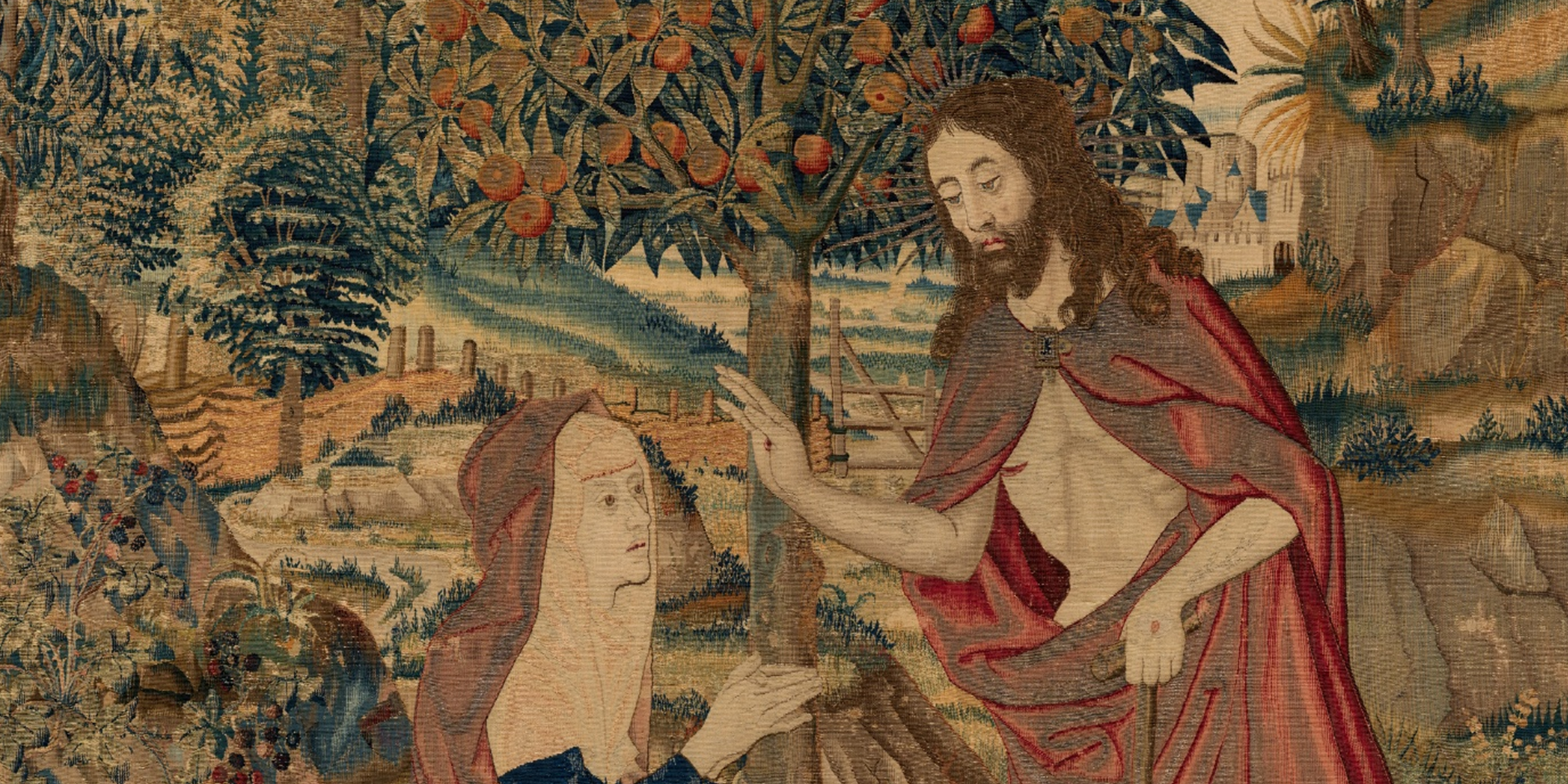
Image Credit: The Resurrected Christ Appearing to Mary Magdelene in the Garden (South Netherlandish, ca. 1500–1520). The Metropolitan Museum of Art, New York. 56.47.
Thank you for reading this article about Why Did Jesus Die?