The Same Seed, Different Soil: What Jesus Teaches Us About Why People Respond Differently to Truth
Introduction – The Question Apologists Eventually Face – Why Do People Respond Differently to Truth?
You listened carefully. You answered the objection honestly. You gave real reasons for what Christians believe. You explained the gospel as clearly as you knew how.
And nothing happened.
Perhaps someone else heard substantially the same case and responded with an entirely different posture — curiosity, conviction, even faith. Every apologist who has been at this long enough eventually runs into the discomfort that creates:
“If truth has been faithfully communicated, why doesn’t everyone who hears it respond in the same way?”
If truth has been faithfully communicated, why doesn’t everyone who hears it respond in the same way?
The natural instinct is to interrogate the presentation. Was the argument weak? Was the evidence wrong? Did I answer the objection actually being asked, or the one I assumed was being asked?
Those are legitimate questions. Poor arguments exist, and Christians should care whether we represent the faith both accurately and well.
But before the apologist spends another year sharpening delivery, Jesus’ Parable of the Sower introduces a variable most of us reach for last: the difference in outcome is not always explained by a difference in what was sown.
One Sower, One Seed, Four Soils
The parable itself, in Luke 8:4–8, is almost deceptively simple. A sower goes out to sow, and the seed falls in four places — beside the road, upon rock, among thorns, and finally on good soil. Only one of the four produces a crop.
The detail worth sitting with first is what stays constant across all four cases: the seed does not change. The same seed encounters different ground.
“The difference in outcome is not always explained by a difference in what was sown.”
Jesus does not leave us to guess what that ground represents. He interprets His own parable directly, in Luke 8:11–15, and that interpretation — not our own allegorizing — controls everything that follows.
“The seed is the word of God” (Lk. 8:11). That single identification reframes the whole scene.
The variation Jesus describes is not primarily a variation in the truth being communicated. It is a variation in what happens when the same word meets different hearers.
Jesus Explains the Hearers
Working through the four soils in Jesus’ own order, and staying inside His interpretation rather than supplying a new one, four distinct apologetic observations emerge.
The Wayside — The Word Never Takes Hold
“Exposure to truth does not guarantee acceptance of truth.”
In the first case, the word is heard, but it never gets further than that. “The devil comes and takes away the word out of their hearts, lest they should believe and be saved” (Lk. 8:12).
Hearing, in other words, is not identical to receiving. A person can encounter the Christian claim — clearly, even compellingly — without ever taking hold of it.
The apologetic implication is worth stating plainly, since it corrects an assumption many of us carry unexamined into every conversation: exposure to truth does not guarantee acceptance of truth. That failure is not automatically a failure of the sower.
The Rock — Reception Without Root
The second case is more unsettling, because it begins so well. These hearers “receive the word with joy” (Lk. 8:13). The initial response is not resistance; it is enthusiasm. Yet Jesus says plainly that they have no root, and when testing comes, they fall away.
This gives apologetics an important distinction it does not always observe carefully enough: immediate enthusiasm is not necessarily enduring faith.
“Immediate enthusiasm is not necessarily enduring faith.”
Someone saying “that makes sense” in the middle of a good conversation has not thereby become rooted in Christ.
Intellectual agreement at the moment of persuasion and settled faith over time are not the same event, and apologetics should be honest about which one it can actually observe in the room.
The Thorns — Truth Competing With Other Loves
The third soil is, for an apologist, the most instructive of the four, because of what Jesus does not say is choking the word.
The seed here grows — it is not rejected outright, and it is not merely superficial — but it grows up alongside “cares, riches, and pleasures of life,” and these eventually choke it out (Lk. 8:14).
Jesus does not attribute this failure to a superior counterargument. The word is not choked by a better syllogism. It is choked by cares, riches, and pleasures — competing loves, not competing claims.
“Not every obstacle to Christian faith is, underneath, an intellectual objection.”
That yields a genuinely useful apologetic observation: not every obstacle to Christian faith is, underneath, an intellectual objection.
A person can raise a real question, worth a real answer, while something far more existential operates beneath it — not a smokescreen, but the actual terrain the word has to grow through.
This does not license the apologist to start psychoanalyzing the person across the table, assigning hidden motives Jesus never claimed to reveal to us. But it should produce real humility about what argument alone can accomplish, and real attentiveness to more than just the argument being made.
The Good Soil — Hearing, Keeping, Persevering
The fourth soil supplies the contrast to the other three: those on good soil, “having heard the word with a noble and good heart, keep it and bear fruit with patience” (Lk. 8:15).
Notice the progression — hear, keep, bear fruit with perseverance. The goal was never merely intellectual assent at the moment of conversation. It was always this fuller thing: a word that takes root and, over time, produces fruit.
What This Does Not Mean for Apologetics
A parable this useful is also easy to overread, so the boundary is worth stating as clearly as the observation itself. Jesus is not offering a technical treatise on apologetic methodology.
The parable does not say arguments don’t matter, evidence doesn’t matter, or reasoning with unbelievers is beside the point.
“The communicator is responsible for faithfully sowing the word; he is not sovereign over the hearer’s response to it.”
And it certainly does not excuse sloppy apologetics after the fact — “well, I gave a poor answer, but apparently he was rocky soil” misuses the text to cover for what was simply a bad conversation.
Christians remain responsible to speak truthfully, accurately, graciously, and as intelligently as we are able.
What the parable establishes is narrower than either extreme, and it is the hinge the rest of this article turns on: the communicator is responsible for faithfully sowing the word; he is not sovereign over the hearer’s response to it.
The Temptation to Take Responsibility for the Harvest
This is where the parable becomes most useful to the working apologist, because it names a temptation most of us share.
It is easy to assume responsibility for both the presentation and the result. If someone rejects the case made for Christianity, the verdict arrives quickly: I failed. If someone accepts it, an equally quick verdict follows: my argument worked.
“If someone rejects the case made for Christianity, the verdict arrives quickly: I failed. If someone accepts it, an equally quick verdict follows: my argument worked. Both conclusions…make the same mistake.”
Both conclusions, however differently they feel, make the same mistake — they assign the apologist a sovereignty over the outcome the parable never grants him.
The sower matters. The sowing matters. The seed, which is the word of God, matters supremely. But the sower does not manufacture the harvest. Seeing that clearly guards against two temptations that sit on opposite sides of the same error: despair when someone rejects what we’ve said, and pride when someone responds well.
Neither outcome makes us sovereign over what occurred in that person’s heart.
Apologetics as Faithful Sowing
None of this loosens the charge Peter gives every believer, to “always be ready to give a defense to everyone who asks you a reason for the hope that is in you” (1 Pet. 3:15).
We should study, reason carefully, and correct bad arguments — including our own — and listen closely enough to hear the actual question being asked rather than the one we came prepared to answer.
“The responsibility given to us is…to bear faithful witness to Christ and His truth.”
But the objective was never to produce conversion. The responsibility given to us is narrower, and more manageable: to bear faithful witness to Christ and His truth.
That reframes the emotional posture of the whole enterprise. The conversation is no longer, at bottom, I have to win this person. It becomes: I need to be faithful with the truth entrusted to me.
That is a very different burden to carry into a difficult conversation — and a considerably lighter one.
The Person in Front of You Is Not “Soil”
One more caution belongs here, because without it the parable can be turned into something Jesus never intended — a taxonomy for sorting people rather than a source of patience for how we talk to them.
No Christian should leave a hard conversation thinking, well, he’s obviously rocky soil, or she’s clearly thorny ground.
“We do not know what God may yet do in a life we have glimpsed for only one conversation.”
Jesus’ parable explains why different responses to the same word should not surprise us. It does not authorize us to hand out permanent classifications to the people we meet.
We do not know what God may yet do in a life we have glimpsed for only one conversation.
Someone who walks away unconvinced today may later hear the Word again and respond differently.
The right response to the parable is humility in the apologist, not labels for the person he was trying to reach.
Conclusion – Sow the Seed and Leave the Harvest to God
Return, then, to where this started. You answered carefully. You presented the evidence honestly. You explained the gospel as clearly as you knew how. And the person walked away unconvinced.
Was the conversation wasted? Jesus does not permit us to measure faithfulness solely by immediate, visible results.
The sower sows. The word goes out. Different hearers, encountering the very same word, respond differently — and that difference was never entirely in the apologist’s hands to control. What remained his to control, all along, was faithfulness.
“We are responsible for faithfully sowing the seed. We were never responsible for manufacturing the harvest.”
The Parable of the Sower does not make apologetics unnecessary. It puts apologetics in its proper place. We can answer questions, examine evidence, expose faulty reasoning, and proclaim Christ as faithfully as we know how. But we cannot make truth take root in another person’s heart.
That limitation should not discourage the apologist. It should liberate him from trying to do what only God can do.
We are responsible for faithfully sowing the seed. We were never responsible for manufacturing the harvest.

Phillip James, MDiv serves as pastor of Seven Springs Baptist Church in Seven Springs, North Carolina, where he and his wife, Brandy, share a heart for serving others and encouraging people in their walk with Christ. Drawing from a background in entrepreneurship, he is currently pursuing a PhD in Applied Apologetics at Liberty University. Phillip is dedicated to expository teaching, helping people understand Scripture, and applying biblical truth to everyday life. You can follow him on YouTube @PastorPhillipJames.
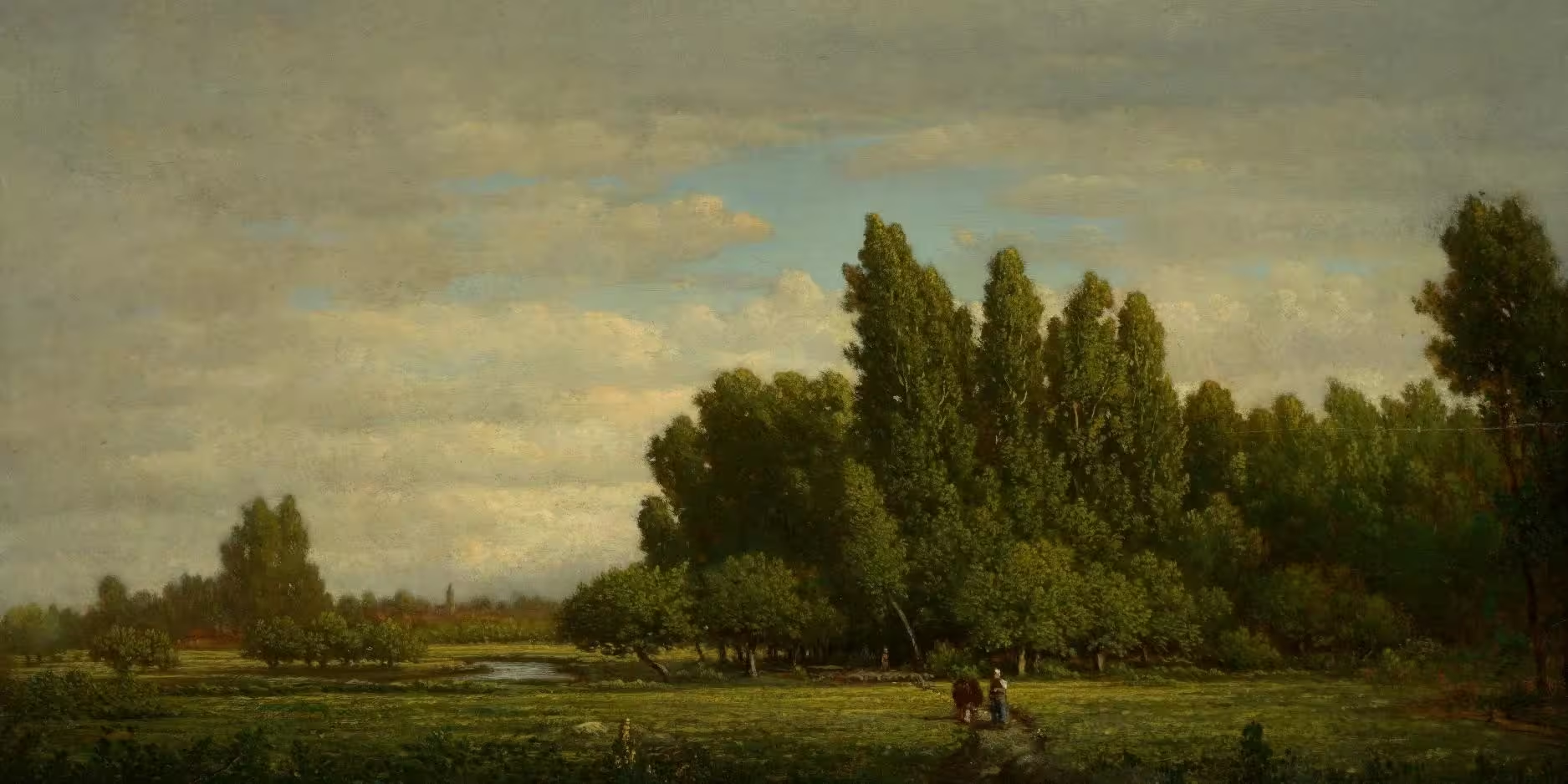
Image Credit: A Meadow Bordered by Trees by Théodore Rousseau (French, ca. 1845–60). The Metropolitan Museum of Art, NY. 11.45.5.
Thank you for reading this article about Why Do People Respond Differently to Truth? Be sure to visit our Topics page to see more articles like this one about Why Do People Respond Differently to Truth?