Ask the Pastor: Can “the Law” Refer to More than the Ten Commandments?
Ask the Pastor is a regular column at Every Reason to Believe where pastor Reagan Marsh answers a variety of reader questions about ministry, Christianity, the church, and more…all from the perspective of the pulpit. You can find all of his articles here.
What Is the Law?
Here is the question I want to handle today:
I have a question about terminology. We can call the Ten Commandments “the law,” “the moral law,” or “the summary of the entire moral law.” But as for the Old Testament writings, doesn’t Jesus denote some of the other books outside of the Pentateuch as “the law?” See John 10:34 and John 15:25 where he quotes Psalms and calls it “the law.”
“Jesus used a very common classification when he spoke of “the Law of Moses and the Prophets and the Psalms” —Torah (the Law), Nevi’im (the Prophets) and Kethuvim (the Writings, which begin with the Psalms).”
In other words, is it helpful or confusing if I quote Scripture to someone and say something like, “The law says, ‘Anyone who turns his ear away from hearing the law, even his prayer becomes an abomination’’? (Prov. 28:9)
Clearly this is found in Proverbs, not in Moses. My desire is not to confuse people, but in my evangelism I do want to convey properly that they are under obligation to God’s standard in his Word.
This is a great question! Let’s consider four points briefly in response.
1. The Old Testament (“OT”) Has Three Primary Categories
Jesus used a very common classification when he spoke of “the Law of Moses and the Prophets and the Psalms” (Lk. 24:44)—Torah (the Law), Nevi’im (the Prophets) and Kethuvim (the Writings, which begin with the Psalms).
Theologians have often termed this the threefold division of the OT (Law, Prophets, and Writings/Psalms) when discussing specifics related to genre.
2. Broadly Considered: We Can Use Two Categories
There’s a broad sense in which we can speak of “all the law and the prophets” (Matt. 22:40; Acts 13:15; Acts 24:14) as encompassing the whole OT.
Quite similarly, the OT speaks of “the law and the testimony” (Is. 8:20) which simply means Moses plus the rest of the OT.
3. There’s Also A Dual Sense: One Category, Used Two Ways
“The law” can certainly encompass the Ten Commandments (Rom. 3:2; Rom.6:15; 1 Tim. 1:8-10), though we also note a final sense in which we may consider “the law” as meaning “the whole OT” in a broad usage (Lk 16:17).
John 10:34 and John 15:25 fall into this category, and it’s what Proverbs 28:9 has in view.
We rightly understand the NT to have expanded that verse’s weight and scope: a man who won’t hear the Bible, won’t hear God.
He has no reason to expect God wants to hear him either. Note the same principle applied in Matthew 6:15.
4. Don’t Overlook A Similar Usage: “The Scriptures”
That dual sense is roughly what Paul’s using when he says Timothy has known “the Scriptures” from his infancy (2 Tim. 3:15)—that is, the OT…the NT was still being written!—though perhaps Torah was specifically in view there.
We also observe Peter using this same term collectively, to encompass the whole OT and to recognize Paul’s letters as properly considered part of the inspired biblical canon (2 Pet. 3:16).
Conclusion
So, “the law” can mean the Ten Commandments, the Pentateuch, or the whole OT.
“When evangelizing or engaging someone who doesn’t know much of the Bible, I usually just speak of ‘the Scriptures’ for clarity.”
When evangelizing or engaging someone who doesn’t know much of the Bible, I usually just speak of “the Scriptures” for clarity, though I don’t hold that as a hard-and-fast rule.
Talk to the person in front of you—apply the Law as needed—and point them to Jesus, who alone is Lawgiver and Lawkeeper, by the grace of his gospel.
He was “obedient unto death, even the death of the Cross,” for us and for our salvation!
Guilty consciences convicted by his law can be cleansed by his grace.

Reagan Marsh, MATS, MDiv (eq.) is founding pastor-teacher to Reformation Baptist Church of Dalton, GA. A certified biblical counselor, Reagan took MATS and MDiv study at NOBTS and SBTS, and is a ThM candidate at CBTS researching Hercules Collins’s pastoral theology under Tom Nettles. He has served in gospel ministry since 1998 and he writes and contributes to numerous Christian publications.
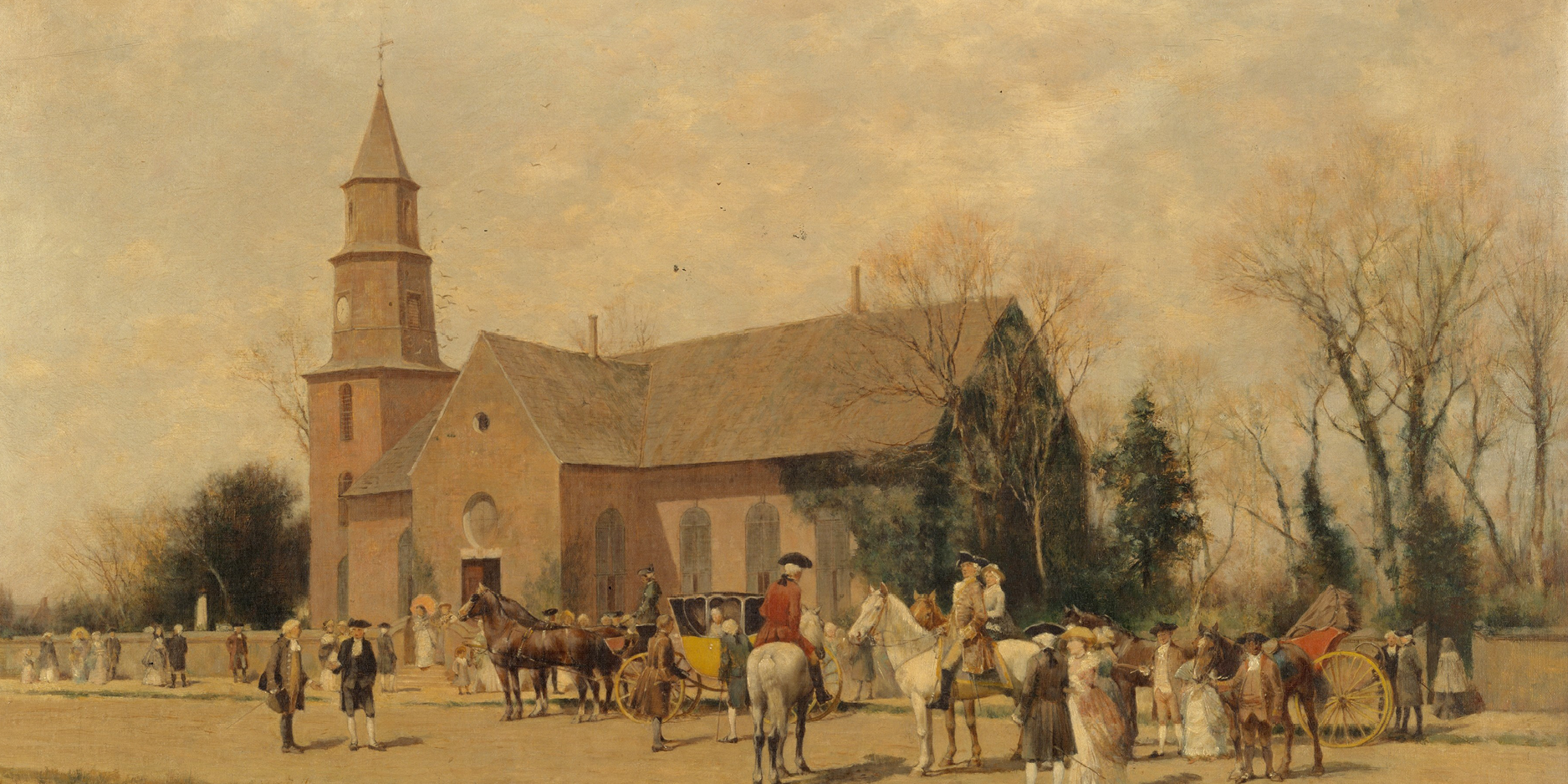
Image Credit: Old Bruton Church, Williamsburg, Virginia, in the Time of Lord Dunmore by Alfred Wordsworth Thompson (American, 1893). The Metropolitan Museum of Art, New York. 99.28.
Thank you for reading this article about What Is the Law?