Ask the Pastor: How Should We Approach Race in the Church?
Ask the Pastor is a regular column at Every Reason to Believe where pastor Reagan Marsh answers a variety of reader questions about ministry, Christianity, the church, and more…all from the perspective of the pulpit. You can find all of his articles here.
How Should We Approach Race in the Church?
I can’t think of many more immediately-pressing and yet perennially-occurring questions than this one.
Here are some points to meditate on to help you begin to form a biblical theology of race in the context of the church, both local and universal.
At the end of this article I also mention some additional conclusions about the topic.
Our Common Life in Christ
Our common creation by God.
(Gen.1-2; Ps. 139:14-16, Jn. 1:3, Col. 1:16, Heb. 1:2)
Our common existence as those created for the glory of God.
(Is. 43:7, 1 Cor. 10:31, 2 Cor. 5:9)
Our common standing as image-bearers of God.
(Gen. 1:26-27, Acts 17:26)
Our common task in the cultural mandate.
(Gen. 1:28)
Our common calling in marriage.
(Gen. 2:23-25, Mal. 2:15-16, Eph. 5:22-33; 6:4 and see also Col. 3:21)
Our common fallenness in Adam.
(Gen. 3, Rom. 5:12)
Our common redemption in Christ.
(Gen. 3:15, Rom. 5.15-21, Acts 10:15)
Our common reconciliation in Christ.
(Jn. 1:29, Col. 1:19-20)
Our common election as saints in Christ.
(Eph. 1:3-12)
Our common adoption into the family of God.
(Eph. 1:5, Rom. 8:15)
Our common baptism in the Holy Spirit at regeneration.
(1 Cor. 12:12-13, Tit. 3:5)
Our common membership in the family of God.
(1 Cor. 12:12-14)
Our common new identity in Christ as sons.
(Rom. 8:14-17 (particularly v. 15), Gal. 3:27-29 (see also Col. 3:8-11), 1 Jn. 3:1)
Our common gifting by the Holy Spirit’s sovereign wisdom.
(1 Cor. 12:4-11)
Our common sanctification through the Holy Spirit’s ministry.
(1 Pet. 1:1-2 (election is the cause), Rom. 8:3-11 (sanctification is the effect))
Our common experience of godly sorrow, practicing true repentance, and growing in holiness unto God.
(2 Cor. 7:1, 8-13, Rom. 8:4, 13)
Our common experience of killing sin and battling the desires of the flesh, which are contrary to the holiness of God.
(Ps. 119:9-16, Eph. 4:22-24, Col. 2:20-3:17)
Our common experience of God’s discipline.
(Deut. 8:5-6, Heb. 12:1-17)
Our common hope in the gospel’s promises.
(Eph. 1:12, 2 Pet. 1:3-4)
Our common faith in Scripture’s trustworthiness.
(Ps. 12:6, Prov. 30:5, Jer. 1:12, 2 Tim. 3:15-16)
Our common dependence upon Scripture’s divine nature.
(Deut. 8:3, Ps. 19:7-11, Jn. 17:17)
Our common obedience to Scripture’s directives—counsels, commands, and cautions.
(Jn. 17:17, 2 Pet. 1:19-20)
Our common submission to one another (that is, church discipline).
(Eph. 5:21, Matt. 18:15-19, 1 Cor. 5)
Our common duty to love one another as Christ loved us.
(Jn. 13:34, 1 Jn. 4:7)
Our common goal in the Great Commission.
(Matt. 28:18-20, Acts 1:8)
Our common experience of God’s providence, often involving suffering under the normal difficulties of life.
(Job 3:1; Ps. 33:18-19, 34:18, 35:17)
Our common suffering, grace, and promise when called to martyrdom.
(Rev. 6:9-11)
Our common experience of communion with God.
(Rom. 8:14-17, Gal. 5:25, 1 Jn. 1:3)
Our common worship of the Triune God.
(2 Cor. 13:14, Rev. 5:13)
Our common eternal future with one another.
(1 Thess. 4:17, Rev. 7:9-10)
Conclusions
1. Racial prejudice, intolerance, or superiority is sin, period. It is contrary to the Scriptures and the gospel and should be treated as the sinful self-interest that it is.
In the church, unrepentant racism should be grounds for congregational discipline.
2. Ethnocentrism and tribalism are misguided at best, and sinful at worst. Each is capable of springing from or walking with sinful racial prejudice.
3. Better communication, condemning or revising history, appeals to psychology, sociology, or anthropology for answers rather than Sacred Writ, forced “reconciliations,” imposed “repentance” (individual or corporate), “heritage not hate” philosophies, ensuring “equitable outcomes,” and even compelling diversity are not the responses Scripture requires.
“Reconciliation is the work of God the Spirit in bringing sinners to repentance, humility, and restored fellowship, on the grounds of God’s having restored us to himself in Jesus.”
Neither are “blood and soil” errors. Attempting to effect reconciliation in Adam is misguided, and the church ought not endorse it.
Reconciliation is the work of God the Spirit in bringing sinners to repentance, humility, and restored fellowship, on the grounds of God’s having restored us to himself in Jesus.
4. Our basis of being members together of the family and household of God is the death and resurrection of our Elder Brother.
Thus our unity is grounded in the commonality of gospel identity, not the commonality of Adamic identity.
We regard no one according to the flesh…not even Jesus (2 Cor. 5:16; 10:12).
5. Our identity in Christ is entirely new: a new creation (2 Cor. 5:17), new family (Eph. 2:19), new name (Rev. 2:17; Is. 56:5, 62:2, and 65.15; Rev. 3:12), new citizenship (Phil. 3:20)—indeed, even a new race (Rom. 2:28-29) and new nation (1 Pet. 2:9-11).
Why would we as Christians insist on defining ourselves by who we were, not who we are?
6. Our walking together must be on the basis of mutual love to our brothers and sisters in Christ (1 Jn. 3:14), imitating God’s love.
God’s love goes to the nations, irrespective of ethnicity (Gen. 12:1-3; Matt. 28:19), and brings near the blessings of his grace in Jesus.
Our love must be transcendent like that. As one writer said well, “The Bible is intolerant of an ‘us’ and ‘them’ perspective within the church of Jesus Christ. The church is ‘we.’”

Reagan Marsh, MATS, MDiv (eq.) is founding pastor-teacher to Reformation Baptist Church of Dalton, GA. A certified biblical counselor, Reagan took MATS and MDiv study at NOBTS and SBTS, and is a ThM candidate at CBTS researching Hercules Collins’s pastoral theology under Tom Nettles. He has served in gospel ministry since 1998 and he writes and contributes to numerous Christian publications.
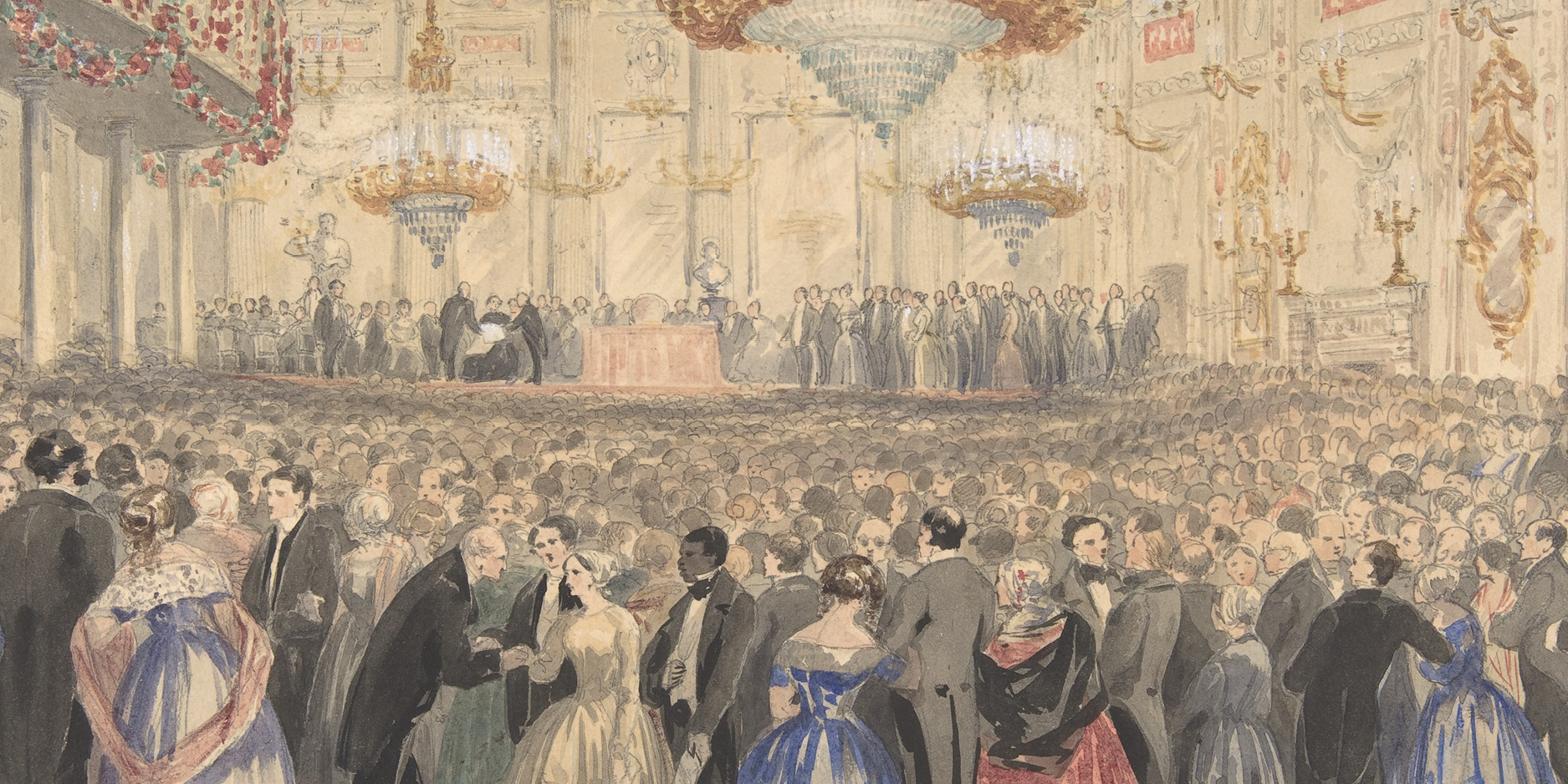
Image Credit: Abolition Meeting Held at Willis’s Rooms in Honor of Harriet Beecher Stowe by William Henry Fisk (British, 1853). The Metropolitan Museum of Art, New York. 55.632.6.