How to Protect Churches from False Teachers
3) For the time will come when they will not endure sound doctrine; but after their own lusts shall they heap to themselves teachers, having itching ears;
4) And they shall turn away their ears from the truth, and shall be turned unto fables.
-2 Timothy 4:3-4 (KJV)
Introduction
In these verses Paul instructs Timothy, who was a young promising pastor at the time, about people who turn away from the truth of the Bible for false teachers and teachings.
Paul’s main point is that people leave the gospel because they have convinced themselves or have been persuaded by others that the Bible isn’t true.
In particular, those who leave sound doctrine do so because they want to follow their own truth. In so doing they trade in the one true God of the Bible for self-satisfying false religions that have no eternal value.
“In recent years stories about the None’s, ex-vangelicals, and deconstructionists have made numerous headlines.”
Sadly, what Paul points out in these verses is nothing new, nor should it surprise us. People have left biblical Christianity since the early days of the church. The same thing is going on today.
In recent years stories about the None’s (religiously non-affiliated), ex-vangelicals (former believers), and deconstructionists (believers of a gospel of their own making) have made numerous headlines.
In fact, the news, and the momentary fame that former Christians get from being on it, has almost made leaving the faith akin to a popularity contest.
However, desertion isn’t just about those who make public “statements” about leaving the church in order to garner attention. Rather, many people who leave Christianity do so without ever leaving a church. What they do is they depart from the gospel within churches.
Notice, Paul says that people “heap to themselves teachers.” Often these are false teachers who consider themselves to be Christians but who do not hold to any of the core doctrines of the Bible.
“Many people who leave Christianity do so without ever leaving a church.”
Cults and sects have operated this way for centuries, they take no shame in claiming their false doctrines to be true. Moreover, those who follow them wouldn’t necessarily consider themselves ex-Christians.
Regardless, whenever people add to or take away from God’s words, doctrines or truths they are then promoting or following an incomplete and counterfeit Christianity.
False forms of Christianity are those that have departed from the one true gospel once and for all delivered to the saints (Deut. 4:2, 2 Tim. 2:18, Gal. 1:6, Jude 3). And again, this happens within the church just as much as does outside the church.
For instance, during the last few decades there have been many mainline churches that have adopted a “reach the culture by being like the culture” approach. Moreover, traditional denominations have given way to non-denominational churches for fear that a denominational label will turn away potential visitors.
There are also some churches that measure themselves on how innovative they are, or the “vibe” they “give off,” and the “authenticity” of their preaching when the reality is there is little if any valid substance to what they preach. Such churches serve the wants of man instead of the glory of God which makes them especially prone to error and false teaching.
Now, let me be clear, just because a church is non-denominational doesn’t mean it’s spreading false doctrine, in fact most non-denominational churches preach gospel truth, and are great churches to be members of.
“God doesn’t need a big church, a fancy church or a modern church, he needs a strong church.”
The point I’m making is that when churches give way to the culture outside of the church they can easily (and often do) compromise doctrine. They wind up teaching what non-Christians want to hear, instead of focusing on what they need to hear.
Remember, God doesn’t need a big church, a fancy church or a “modern” church, he needs a strong church, namely one that follows his words for his glory.
It’s no coincidence that in the two verses before Paul’s warning to Timothy about false teachers that he exhorts Timothy to preach the word whether the culture cares or not (2 Tim 4:2). Specifically, Paul teaches that pastors are to “reprove, rebuke” and “exhort with all long suffering and doctrine.”
Pastors must speak the truth in love in every season and must hold to sound doctrine (Titus 2:1, Acts 2:42, Eph. 4:15) to protect themselves and their congregations from false teachers and teachings.
While this is as important now as it’s always been, today there are unique circumstances that pastors would do well to be aware of in order to protect their flocks from false gospels.
The rest of this article will examine current cultural trends that are making it easy for believers to fall into false teaching, as well as exploring how pastors can overcome current challenges and protect their flocks.
The Attention Economy
Many Christians today are more vulnerable than perhaps at any point in history to be convinced or persuaded to leave biblical truth. Why? Because everyone today is trying to get our attention. This is called the attention economy.
Regrettably, the environment many of us live in today demands that people compete for our attention. We’re all engulfed in data, decisions and information.
“The environment many of us live in today demands that people compete for our attention. We’re all engulfed in data, decisions and information.”
In fact, we consume more information today and make more decisions on a daily basis than most people ever did throughout almost all of human history. Also, most of us can be reached at any time by (theoretically) anyone, which adds another layer of complexity to the attention economy.
The dichotomy of being constantly distracted with information and being readily available has created an entire economy and culture defined by marketers, influencers and leaders trying to get our attention through a myriad of communication methods.
From a purely business standpoint it makes sense. Attention begets sales, and sales incur profit. This helps explain why digital marketing has become a race to the bottom. For example, every time a new piece of technology is released marketers quickly learn how to exploit it for the greatest financial gain. Soon enough ads are everywhere until the same happens to another new form of technology or communication.
All of this naturally spills over into areas beyond just business. False teachers who are good at marketing for instance can easily capture our attention.
Just like the apple in the garden, false things are often visually appealing (Gen. 3:6). And its not just things; for example we tend to naturally trust people who are more attractive (the “halo effect”).
Additionally, sometimes those with the biggest budgets and “influence” can reach more people with false information and narratives to persuade them away from gospel truth.
“The attention economy and our natural inclination to want things both make for a challenging environment for pastors and churches to operate in.”
But its not just big business or slick marketers who are to blame for this. Each of us are culpable too. Why? Because we like to be marketed to.
This was one of the central points of Daniel J. Boorstin’s masterful 1962 book The Image: A Guide to Pseudo-events in America. Even back then social scientists knew that people like to be courted by companies, products, fashions, leaders and more.
We love being “won over” by clever advertising; even when we say we don’t like ads we do (we just don’t like ads that we don’t personally like!). Think about it…why do so many people want to watch Super Bowl ads? Because they like to be entertained and courted by advertisers.
Therefore, the attention economy and our natural inclination to want things both make for a challenging environment for pastors and churches to operate in. It’s also a relatively new environment that didn’t exist for most people throughout history.
In fact, there are three major challenges facing pastors due to our culture’s advertising first environment. They are, apathy toward truth, being theologically uninformed, and careless decision making.
“We’ve got so much coming at us today and we just can’t or don’t want to keep up, so we don’t devote enough of our energies to discerning if what we’re being told to believe is true.”
First, people can easily succumb to false teaching because they just don’t care about truth. They are apathetic toward truth. The constant bombardment of marketing stimuli today easily elicits a “go with the flow” mentality that many adopt. Not to mention our obsession with screen time, and trading embodied experiences for digital ones.
Put another way, we’re always “on” but never really engaged with anything; our lives are passive and not actively engaged with life. We just consume, we don’t participate with things or people.
Additionally, we’ve got so much coming at us today and we just can’t or don’t want to keep up, so we don’t devote enough of our energies to discerning if what we’re being told to believe is true.
Second, the “too much of everything” nature of the modern world has made us the most educated people ever, yet we’re often less informed than we’ve ever been, especially theologically.
For instance, it’s difficult to find vetted information today, it takes time to compare different sources of the same news story to form an informed opinion, and most of all the art of critical thinking has been lost in all of this.
In fact, we don’t even read like we used to (see the excellent book Reader Come Home by Maryanne Wolf). We simply scan, skim and can’t stay focused on texts that actually demand something of us.
This has a detrimental effect on how we read the Bible by the way because the Bible is not a transactional marketing piece, blog article, or a boring, irrelevant ancient book. Rather, it’s a transformative work that we must wrestle with. We must meditate on God’s word, study it and apply it to our daily life in order to reap its life-giving and life-changing powers. However, our culture today makes that difficult; we either can’t find the time, the energy or the mental willpower or focus to devote our attention to the text.
“The triple threat for pastors today is that congregants can often be apathetic toward truth, theologically uninformed, and careless when it comes to making decisions…these tendencies make Christians highly vulnerable to…false teachers and teachings.”
Lastly, the attention economy easily draws people into fast and foolish decision making due to the allure of fame and fast rate of change in the modern world. It’s easy to be a careless decision maker today.
For example, we make choices for five seconds of fame, or out of a fear of missing out or we jump on bandwagons because everybody else is doing it. We don’t stop and consider, or count the cost. Or we feel like we have to keep trying to do more, do enough and keep up with the times when everything around is changing faster than it ever has (consider how different the world is now than it was even several years ago!).
Therefore, the triple threat for pastors today is that congregants can often be apathetic toward truth, theologically uninformed, and careless when it comes to making decisions. Combined, these three tendencies make Christians highly vulnerable to succumbing to the lies of false teachers and teachings.
Also to clarify, do many act like this intentionally? Yes and no. While we certainly are to blame for some of this, the point I’m making is that the current cultural environment causes many difficulties for us especially in regards to our attention and critical thinking skills, which for many is by no fault of their own. That’s why pastors need to be aware of current trends.
Now, before we look at how pastor’s can respond to these modern tendencies, we need to talk more about the power of persuasion in the modern world.
Protection from Persuasion
While the attention economy might be new, persuasion is certainly not. Paul knew this back in the first century.
All of us want to be involved with things that either appeal to something in us that we selfishly want or that we can indulge in. That’s what Paul means when he says to Timothy “after their own lusts shall they heap to themselves teachers” (emphasis mine).
To lust after in this context means to covet, or to want to believe something other than the God’s word.
“A major root cause of people leaving the gospel is that they do not like what God says, and instead want it their way.”
As James points out, “every man is tempted, when he is drawn away of his own lust, and enticed” (Jas. 1:14). Our selfish desires draw us away, and we are easily persuaded or enticed.
Sadly, many leave the faith because deep down they want to; they seek out false teachers. Still others are persuaded by eloquent teachers or false doctrines that tap into their lusts and entice them away.
Either way, a major root cause of people leaving the gospel is that they do not like what God says, and instead want it their way.
Paul says that those who leave the faith are those who “will not endure sound doctrine.” They don’t want to accept the truths of Christianity. So, they turn away their ears from the truth.
By turn away Paul does not mean a passive departure. In fact, to be turned away means to outright reject, rebel and revolt against. Rejecting the truth means to be against it, to demolish it for new ideas of truth. It is then so often the case that those who leave the gospel leave it and are then hostile to it.
“Persuasion is powerful, and we know Satan and his army are excellent at speaking lies to us. Adam and Eve fell for it, it’s the oldest trick in the book.”
But what is the end of such people? Sadly, they wander off into a land of “fables”—compelling stories and tales that turn them away from the truth.
Persuasion is powerful, and we know Satan and his army are excellent at speaking lies to us (Jn. 8:44). Adam and Eve fell for it, it’s the oldest trick in the book (Gen. 3:4-5).
But again, pastors must do their part and preach the whole counsel of God even when the culture doesn’t deem it appropriate to do so. They must keep watch over their flocks, and preach against the sin of lust.
Perhaps most importantly, pastors and their congregations must be aware of man’s predilections and predispositions to sin and take that seriously.
How Pastor’s Can Protect Churches from False Teachers
So far, we’ve seen how various aspects of contemporary culture can easily persuade people to turn from biblical Christianity.
This is due in large part to the modern attention economy which tirelessly tries to grab people’s attention, with many going to great lengths to persuade people to purchase or follow something.
Compounding this is the fact that many today are engulfed in a constant inflow of information that deadens our focus and ability to think critically about things.
Additionally, because of man’s sin nature, people are still their own worst enemies today as they’ve always been in that they like to be marketed to and can be easily persuaded to act upon their lusts.
“Christianity and faith are not based on fleeting, temporary feelings, but on the truths of God’s word.”
Nevertheless, hope is not lost. In light of current challenges, there are several things pastors can do to protect their churches from false teachers and teachings.
First, pastors can emphasize from the pulpit the importance of facts over feelings. Christianity and faith are not based on fleeting, temporary feelings, but on the timeless (eternally relevant and applicable) truths of God’s word.
Moreover, we go to church and follow Christ because we love him, not because he makes us feel good (1 Jn. 4:19, 1 Jn. 5:2-3). In fact, God calls to higher standards than what the world has to offer; he wants us to be more like him and the Christian life is all about us becoming Christ-like, to be who he originally created us to be, instead of being slaves to sin (Phil. 1:6, 1 Cor. 6:20, Lk. 1:75). As such, pastors would do well to preach against the concept of “following one’s heart,” or “trusting in your feelings” and instead instruct people to follow what God says.
Second, pastors can teach believers to think critically. This applies both to understanding the Bible and understanding cults; both learning the correct and false forms of the gospel. Additionally, it means teaching people how to respond to false worldviews and logical fallacies.
God wants you and I to think – to reason and decide (Is. 1:18). For example, Paul “reasoned” with the Jews and Gentiles at Corinth (Acts 18:4). God commands us to be still and know that he is God (Ps. 46:10). God’s word is taught (2 Tim. 3:16). We have to seek after God and think on things that are good (Prov. 8:17, Phil. 4:8).
To cultivate a flock of effective thinkers, pastors can encourage church members to learn what God’s word really says, not what they want it to say. This also involves teaching how to read the Bible in light of the proper context and genre and not reading into it what the current culture wants it to say or has changed it to say.
“To cultivate a flock of effective thinkers, pastors can encourage church members to learn what God’s word really says, not what they want it to say.”
Lastly, believers can learn about the dangers of jumping to conclusions, how to recognize assumptions, how to have a healthy skepticism, how to avoid trivial or superficial approaches to understanding and how to think through things.
Third, pastors must preach the whole counsel of God, which means the entire Bible (Acts 20:27).
All scripture is inspired and all of it is profitable for us (2 Tim. 3:16). We are to meditate on scripture, to observe, and to do according to all that is written therein (Josh. 1:8) and that includes understanding the meat of the word or the more difficult passages of scripture (Heb. 5:13-14) so that we can discern both good and evil.
Moreover, when the entire Bible is preached, it helps believers cultivate spiritual disciplines over the course of their lives.
“Our decisions, discernment and approach to the world must all be sifted through the lens of God’s word.”
This is how Christians become mature in their faith, and mature Christians are not so easily distracted by the attention seeking movements of the modern world.
Rather, mature believers are focused on God’s glory, and the aim for all teachers and pastors is to present believers as mature in Christ (Col. 1:28). In so doing no parts of scripture are to be held back, for you never know what will be profitable to someone (Acts 20:20).
Fourth, pastors can teach congregations how to be in the world but not of the world (Jn. 15:19). Christians are set apart, a chosen generation whose citizenship is in heaven and who are not to be conformed to this world but who are to be continually proving “what is that good, and acceptable, and perfect, will of God” (Rom. 12:2).
Christians must prove all things (1 Thess. 5:21) and bring every thought captive into the obedience of Christ (2 Cor. 10:5). This doesn’t mean we are to leave the world, but it means that we maintain a healthy and right view of life with our sights set on heaven (an eternal perspective). It also means we take sin seriously, and that we never become too attached to the things of earth (1 Jn. 2:15-16).
Ultimately, the Bible is the supreme standard by which all other forms of thought must agree with. Everything is subservient to scripture, it’s not the other way around (Eph. 1:21-22). Our decisions, discernment and approach to the world must all be sifted through the lens of God’s word.
Conclusion
This article examined current cultural trends that are making it easier for believers to fall into false teaching.
While people leaving the faith is nothing new, many of the current trends are a part of the modern “attention economy” where we’re constantly assaulted with attempts at grabbing our attention and focus away from reality, truth and beauty.
In light of the attention economy, we discussed how Christians can often be apathetic toward truth, theologically uninformed, and careless when it comes to making decisions. Combined, these three tendencies make Christians highly vulnerable to succumbing to the lies of false teachers and teachings.
But we also learned that not all hope is lost and we explored how pastors can overcome current challenges and how to protect churches from false teachers.
“A church comprised of mature, critical thinking Christians who feed on the entirety of God’s word, and who approach false claims with skepticism will not be easily shaken, nor will they quickly follow ‘cunningly devised fables’.”
First, pastors can emphasize the importance of facts over feelings, for Christianity is based on what God says, not what we feel or what the culture says or thinks is right. Second, pastors can teach believers to think critically for God wants us to think, reason and decide (Is. 1:18).
Third, pastors must preach the entire Bible (Acts 20:27) for all scripture is inspired and all of it is profitable for us (2 Tim. 3:16). Fourth, pastors can teach congregations how to be in the world but not of the world (Jn. 15:19) by maintaining an eternal perspective and not becoming overly attached to the things of this world.
Ultimately, by learning how to protect congregations from false teachers and teachings, pastors can build strong, thriving, God-centered churches that can also respond winsomely to those who have left the faith while remaining grounded and mature in God’s word and sanctifying work in their lives.
A church comprised of mature, critical thinking Christians who feed on the entirety of God’s word, and who approach false claims with skepticism will not be easily shaken (Ps. 16:8), nor will they quickly follow “cunningly devised fables” (2 Pet. 1:16).

J.R. Waller, MBA is a Christian lay-teacher, author, and Founder of Every Reason to Believe. He holds an MBA from Rollins College, B.S. in Psychology from The University of Central Florida, Certificate in Christian Apologetics from Biola University, and Bible Knowledge Certificate from The Master’s Seminary Institute for Church Leadership. He is also a two-time Fellow (UCF, The James Madison Institute).
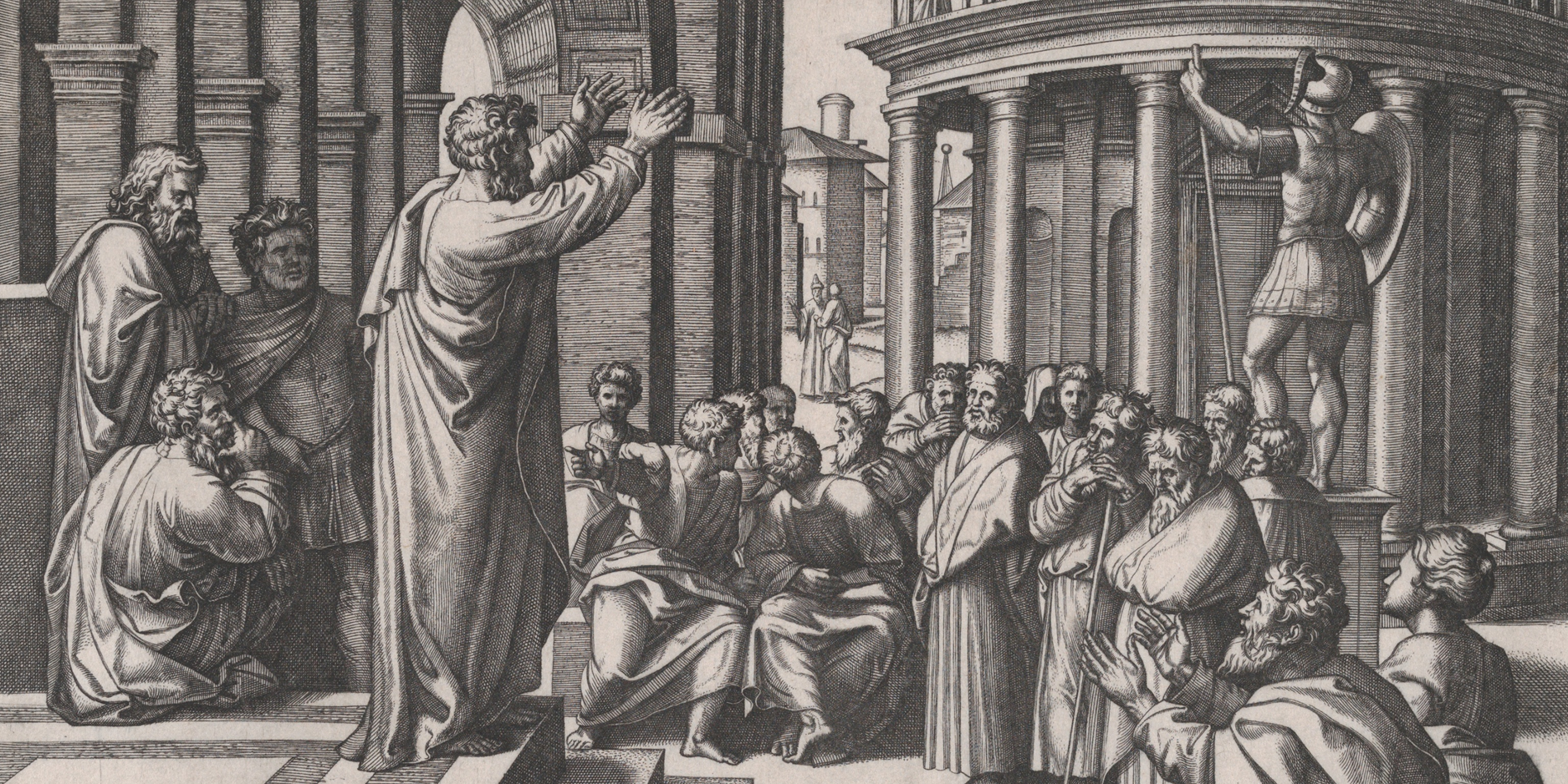
Image Credit: Saint Paul preaching in Athens, after Raphael by Marcantonio Raimondi Italian, After Raphael (Raffaello Sanzio or Santi) – Italian ca. 1517–20. The Metropolitan Museum of Art, New York. 17.50.94.
Thank you for reading this article about How to Protect Churches from False Teachers.