Can Civilizations Survive Without Religion?
Introduction
Religion plays a prominent role within the fabric of civilizations. It always has throughout history. As such, religion matters just as much now, whether we acknowledge it or not, as it always has; it’s an essential source of vitality for societies across the globe.
However, can civilizations survive without religion? Moreover, what are the signs of religious decline in a culture and what happens to a civilization that loses its religious moorings? This article explores all of these questions and more.
Note, while biblical Christianity isn’t so much a religion (a man-made system that attempts to discover meaning) as it is a relationship with Jesus Christ (something that is entirely God’s idea, not man’s), for the sake of this article I’m going to refer to Christianity as a religion.
Christopher Dawson’s View
The eminent Catholic historian Christopher Dawson (1889-1970), in his exceptional groundbreaking sociology book Progress & Religion (1929) describes humans as having an innate affinity for religion. He also teaches how our desire for the religious, and for meaning, must be respected by greater cultures wherein we live in order for said cultures to thrive as civilizations.
According to Dawson, “every living culture must possess some spiritual dynamic, which provides the energy necessary for that sustained social effort which is civilization.” (1)
We all want answers to life’s big questions. However, we need the proper outlet for them and that outlet is religion, and ultimately in a relationship with Jesus Christ as our savior.
“If we don’t have a place we can go to where we can find sufficient answers about life, meaning and purpose, we will naturally transfer our energies for those answers into other things.”
Dawson also states, “the fact that religion no longer finds a place in social life does not necessarily involve the disappearance of the religious instinct. If the latter is denied its normal expression, and driven back upon itself, it may easily become an anti-social force of explosive violence.” (2)
If we don’t have a place we can go to where we can find sufficient answers about life, meaning and purpose, we will naturally transfer our energies for those answers into other things.
Those other things can by anything (money, power, sex, etc.) but regardless of what it is you place your purpose in outside of Jesus Christ, it will never ultimately satisfy.
Additionally, such other things will replace Jesus with your own religion. When that happens, the things of man take God’s place, and they always fail to live up to what they promise. If anything, the lust of the flesh, the lust of the eyes, and the pride of life (1 Jn. 2:16) only serve to distract, confuse and destroy.
Only Jesus is meant to handle our deepest questions and needs, nothing else can or should.
When Religion Loses Relevance
Sadly, we don’t naturally go to God to meet our deepest needs. We are all naturally inclined to make our own rules, and when that is or becomes the norm for a given culture then said culture defines itself not by what God says, but by what man says goes.
In such a culture religion can still exist, but it exists as a shadow of what it truly is and once was. With the passage of time, it gradually becomes an increasingly watered down version of itself.
In a culture where we make the rules, God’s true magnificence and power are diminished. God is still there for us, but no longer as our sovereign Lord. He now becomes someone who’s there solely to meet our needs, instead of us being alive for him. Put another way, we lose reverence for him.
Another side-effect of man’s shift away from God and religion is that God gets co-opted into the secular and slowly but surely Christianity becomes purely cultural and increasingly irrelevant.
This is why some say we live in a post-Christian West – Christianity is around, but not relevant. It’s like an antique, a relic from a former age, it’s intriguing but just an old-fashioned curio (lest we forget that God’s Word applies equally to all civilizations in any period of time, it never changes and is just as powerful now as it always is).
“In a culture where we make the rules, God’s true magnificence and power are diminished.”
Andrew Wilson, in his recent (and excellent) book Remaking the World: How 1776 Created the Post-Christian West, does an excellent job showing how Christianity, especially since the Enlightenment, became co-opted by mainline culture which essentially turned it into something nice but no longer essential to real life. Christianity was, in many ways, twisted into irrelevance.
He states, “contingent religious beliefs now sound like self-evident secular truths…Christianity…became a victim of its own success. It baked its moral norms so deeply into Western culture that people eventually forgot where they came from.” (3)
Cultural Christianity (Christianity that is so commonplace that people overlook it) is a side-effect of religious decline, particularly the decline of reverence toward religion. This is especially prevalent in America.
For instance, in the United States if you ask someone if he or she is a Christian many will immediately say yes, but if you ask why you get many non-Christian answers such as “because my parents were,” or “because I attend a church,” or “because I’m a good person.”
However, none of those answers define or describe what a true Christian is (someone who follows Christ and has trusted him for their salvation and forgiveness of sins by his death on the cross).
Religious decline then can also be thought of as a sort of displacement of meaning. Once the meaning is gone, the long slide into irrelevance begins and people drift further and further away from the truth and reality that a given religion is actually defined by.
Moral Ambiguity and Inconsistent Living
A further problem with religious decline is that when Christianity goes to the wayside, there’s no longer an objective standard for people to evaluate life by. Instead, we make our own rules and try to adhere to them.
However, this leads to massive inconsistencies when it comes to living out life because without an objective moral standard outside of ourselves, everyone is left to their own opinions and ideas of what’s good, right and wrong. For example, moral relativism makes no one’s view of right or wrong valid. So what’s the point?
There’s evidence of moral ambiguity and inconsistent living all around us. For example, people are told to value life, others and be kind while at the same time being taught concepts like individualism, personal autonomy and “expressing yourself.” Put another way, we’re supposed to do unto others as we’d want done to us, while simultaneously doing what feels right.
“Another side-effect of man’s shift away from God and religion is that God gets co-opted into the secular and slowly but surely Christianity becomes increasingly irrelevant.”
We’re taught to be selfless but selfish. How can you have both though? It all sounds good on the surface, but it doesn’t take long to realize that this makes no real sense whatsoever. It’s simply what happens when Christianity is replaced by man-made systems which always change and are thoroughly unable to answer real questions and give direction when it comes to morals.
Only Christianity allows a person to lead a consistent moral life. Without it, morals become murky and led by whatever is the moral flavor of the day.
Confusion
Furthermore, in God’s absence, what is morally acceptable and valued according to people changes constantly. This causes unremitting confusion, and it’s not the way God wants things, he doesn’t operate on confusion at all, his message is clear as our he expectations for us and explanations about life.
Without God, who gets to set the rules? It’s always changing, things are re-interpreted, and re-imagined in an endless cycle. Additionally, human energy is displaced into always having to adapt to new ways of thinking and living, and into trying to find new answers to life’s most important questions.
In such environments cultural confusion makes people channel their energies and beliefs into things that were never meant to be religious at all. This is why many people look to everything but God and make said things their own personal religion. But when nothing else satisfies like Christ, what happens? History provides many helpful clues.
“Only Christianity allows a person to lead a consistent moral life. Without it, morals become murky and led by whatever is the moral flavor of the day.”
As Andrew Wilson points out, our cultural instability today is due in large part to the fusion of Ex-Christianity and Romanticism. They have a tense relationship with each other, i.e. they are two value systems that are quite different. For example, as previously mentioned, self-sacrifice vs. self-actualization. That tension is divisive and creates instability. It’s a clash of values that try to blend together. (4)
Dawson adds, “social revolution is an index of spiritual change,” and “the revolutionary attitude – and it is perhaps the characteristic religious attitude of Modern Europe – is in fact nothing but a symptom of the divorce between religion and social life.” (5)
Instability, revolution, violence, tension, these are the byproducts of a culture where religion and God have become irrelevant, and where moral ambiguity and inconsistent thought have led to cultural confusion. Such confusion creates unsteadiness in all areas of life from community and identity to purpose and meaning.
The Final Decline…or Is It?
Where does a culture or civilization ultimately end up after losing its religious moorings? Perhaps a better question is whether we can handle a world without God and religion?
Can we shoulder the weight of constant change, inconsistent systems and moral confusion on our shoulders indefinitely? The evidence around the world is certainly showing we can’t.
Depression, anxiety and suicide rates are skyrocketing among the young. Meanwhile, social isolation, loneliness, and cynicism are fast becoming the norm. In fact, we now have an entire generation labeled the “Anxious Generation,” so termed by author Jonathan Haidt in his eye-opening book of the same name.
“Leisure, ease, health, wealth and all of that are (at least generally) better now than they were in the past in many parts of the world. But material success has nothing to do with moral progress.”
Also, families have been torn apart after decades following man’s ideas of what it means to be a responsible adult. Sadly, 25% of children in the US don’t grow up in a two-parent household. Also, about 67% of men participate in the US labor force today, down from 87% in 1950.
Despite evidence to the contrary, some might still point out how much progress we have made. Many of us are living the good life now right? Aren’t we better off today than we were in the past?
In many ways we are (though that is also open to discussion in lieu of historical economic data compared today), however, that’s only if we measure progress in terms of material progress.
Leisure, ease, health, wealth and all of that are (at least generally) better now than they were in the past in many parts of the world. But material success has nothing to do with moral progress.
Moreover, moral progress (or moral improvement) is a far more difficult thing to track. Still, Jesus says that we can know the character of another “by their fruit,” and by fruit he means “conduct,” and “actions” (Matt. 7:16).
God knows the hearts of everyone (Prov. 21:12). A person’s status means nothing to God, rather his or her character is what he deems important. That’s why he spends a great deal of time molding and shaping Christians to be more like himself (sanctification, self-denial, etc.).
“Just because a culture has high standards of living or a highly intelligent citizenry doesn’t mean a culture is spiritually alive or morally wealthy.”
So yes, many today live in a materially better world, but they’re unhappy, lonely and burned out. Many are sadly realizing that man’s rules and systems, without Jesus, or religious influence, don’t satisfy.
The world’s promises are like the Serpent’s promises in the Garden of Eden (Gen. 3:4-5), they are false promises, albeit at times attractive ones (Gen. 3:6), but destructive ones nonetheless.
Dawson noticed this too, in Progress & Religion he writes about how just because a culture has high standards of living or a highly intelligent citizenry doesn’t mean a culture is spiritually alive or morally wealthy. Quite the contrary, wealth, status, and prosperity can do a good job at hiding inner social decay. Material progress can be quite an illusory marker of success.
He states, “If intellectual progress – or at least a high degree of scientific achievement – can co-exist with vital decline, if a civilization can fall to pieces from within – then the optimistic assumptions of the last two centuries concerning the future of our modern civilization lose their validity.” (6)
“The world’s promises are like the Serpent’s promises in the Garden of Eden (Gen. 3:4-5), they are false promises, albeit at times attractive ones (Gen. 3:6), but destructive ones nonetheless.”
Moreover, “The danger to (Roman) civilization came, not from any lack of vital energy, but from a sudden change of conditions – a material revolution, which broke down the organic constitution of the society.” (7)
Even in the 1920s, Dawson was questioning the long-term viability and sustainability of cultures that drift from religion’s influence.
Fast forward to 2025, and Andrew Wilson observes that “the ex-Christian world is living off its inheritance. The disturbing question is: What if the legacy runs out? Is there a finite amount of leftover Christian capital available, and if so, what happens when we have spent it?” He gives three possibilities – it runs out and the West will “collapse into a weird chimera of nihilism, tribalism and decadence.” Or Christianity triumphs over Christendom. Or we all run back to our Father like the prodigal son after our ex-Christian world has spent all its inheritance. (8)
Dawson, Wilson, and many others have and still are calling into question the resilience of religiously agnostic societies. More importantly, they beg questions about what finally happens to such civilizations.
Perhaps one of Dawson’s most known quotes best sums it up, “a society which has lost its religion becomes sooner or later a society which has lost its culture.” (9)
But Does Religion, or Christianity for that Matter, Really Matter?
Yes, it certainly does! We’re all seekers at one level or another regardless of whether we admit it or not. We know, deep down, that we have limits physically, mentally and emotionally. Our conscience instinctively gives us the ability to discern between right and wrong. We also have an inward sense of the divine and that there must be more to life. In fact, none of us are without excuse when we turn a blind eye to God or sin (Rom. 1:20-21).
Also, humans are the only beings that can reason and ask questions about their own existence. Humanity needs religion to pour its energy into, and more importantly to find rest in Jesus Christ.
It is only through Christianity where individuals and societies can find true answers and rest.
Christianity brings clarity to questions about what it means to live in community. For example, Christians are members of God’s family, the church, which is the ultimate and eternal community of God. Moreover, the church acts as a mediating institution in society; its socially beneficial, those who attend church live longer, and the church builds bridges between people while also helping people and cultures develop values and traditions.
Christianity also answers questions about identity. Christianity helps individuals look beyond their desires and who they feel or think they are and toward something far better; an identity that doesn’t need approval from others, that doesn’t have to perform for status and that is far better and beneficial for us than who we can ever think we are.
Through Christianity we can know who we are. Christians learn and experience what it means to look to Christ and have him as their identity. Believers rest in the wonderful fact that each man and woman is uniquely created by God as he wants them to be – made in his image as men and women fit for his service.
“Christianity’s profound, satisfying and consistent answers about community, identity, purpose and unity are the foundations of great civilizations.”
Biblical Christianity also cultivates purpose. We learn that serving God out of love for him and what he has done in our lives is the most deeply rewarding form of work we can ever engage in. We also serve others, accomplish his will for our lives and grow in him as ever more morally better people (even if we stumble from time to time, which we do!).
Lastly, and most important for the sake of civilizations, is that the Christian religion fosters unity, common thought and cultural direction. Christians are brothers and sisters in Christ, they share in their desires to obey and follow Christ and they know that what is done on earth has eternal purpose and significance.
In the end, Christianity’s profound, satisfying and consistent answers about community, identity, purpose and unity are the foundations of great civilizations—Civilizations that apply their laws consistently, that share common purpose and direction and that can stand the test of time through shared vision, strong families and reverence to God.
Conclusion
There are signs that much of the West is on shaky cultural ground. What happens next is up to us. Perhaps the question then isn’t if cultures can survive without religion, but instead, would a culture in which no religion exists be one that you’d want to live in?
Without Christianity, you have inconsistency, confusion and instability. With it, unity, a higher authority to guide us, clear boundaries between right and wrong, defined roles for people, meaning and purpose, values and tradition, and the list goes on.
I know which kind of culture I’d want to live in, and I hope you do too.
Ultimately, God is using his gospel to redeem his people back to himself for all eternity. And for Christians whether we live in a culture here on earth that has drifted away from God, or in one that reveres him, we are already part of God’s eternal Kingdom of Heaven.
Can civilizations survive without Christianity? At least we know one thing, God’s eternal civilization will last forever, and it’s built entirely on religion.

J.R. Waller, MBA is a Christian lay-teacher, author, and Founder of Every Reason to Believe. He holds an MBA from Rollins College, B.S. in Psychology from The University of Central Florida, Certificate in Christian Apologetics from Biola University, and Bible Knowledge Certificate from The Master’s Seminary Institute for Church Leadership. He is also a two-time Fellow (UCF, The James Madison Institute).
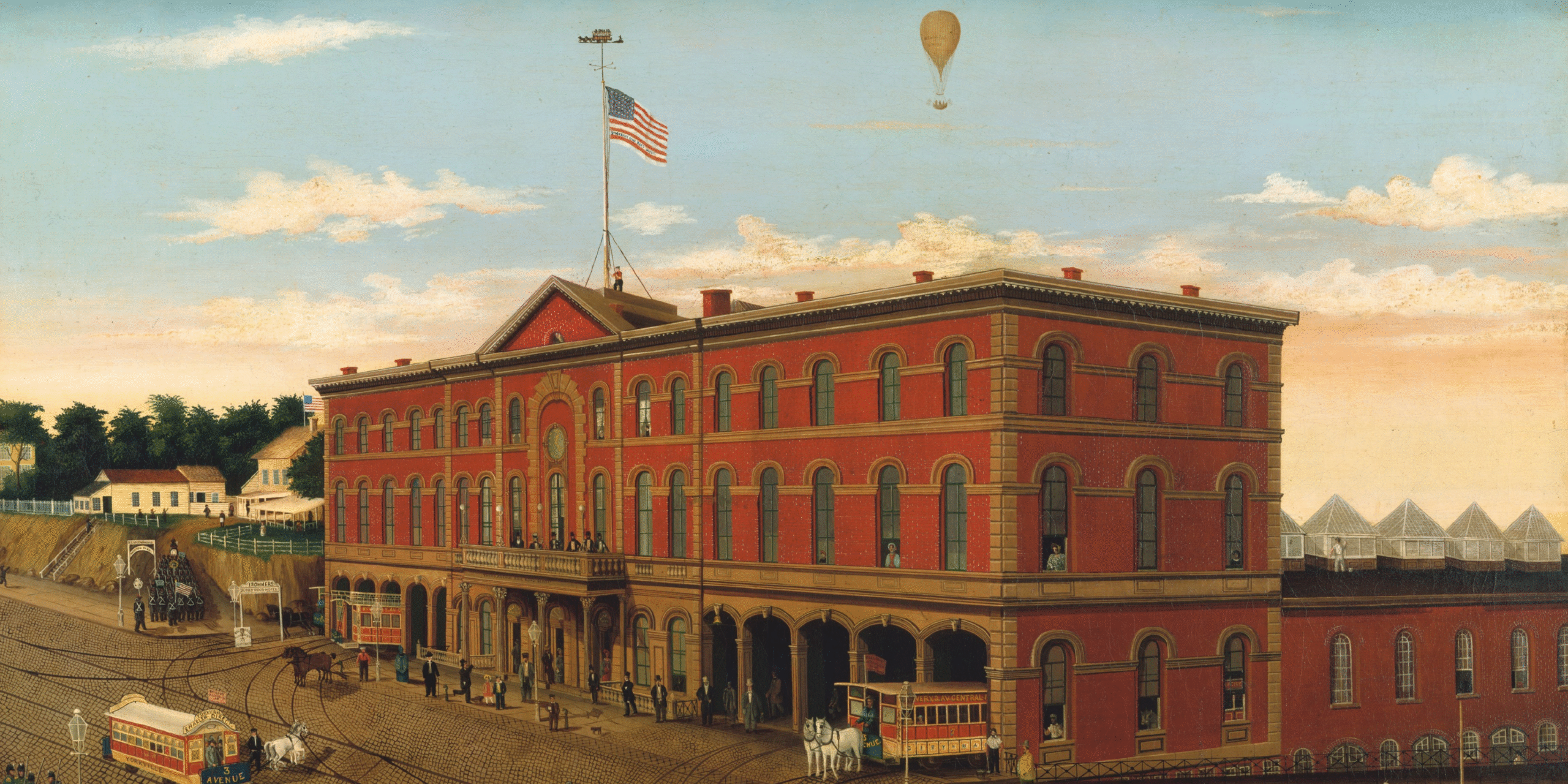
Image Credit: The Third Avenue Railroad Depot by William H. Schenck, American (ca. 1859–60), The Metropolitan Museum of Art, NY. 54.90.178.
References for this article about civilization and religion…
(1) Progress & Religion: An Historical Inquiry by Christopher Dawson (2001), The Catholic University of America Press, Washington, D.C., p. 3-4.
(2) Ibid., 177.
(3) Remaking the World: How 1776 Created the Post-Christian West by Andrew Wilson (2023), Crossway, Wheaton, Il., p.133.
(4) Ibid., p. 35.
(5) Progress & Religion p. 152 and p. 178.
(6) Ibid., 60-61.
(7) Ibid., 166.
(8) Remaking the World, p. 160.
(9) Progress & Religion, p. 180.